Factlens Story, the foundation
The foundation behind Factlens. By founder, Shahed Iqbal & Co-founder, Rakibul Ansary
Insights
Notes on products, systems, company building, and the choices that shape durable technology.
28 Blogs Published so far
Next step
Send the context and the decision you are trying to make.
The foundation behind Factlens. By founder, Shahed Iqbal & Co-founder, Rakibul Ansary
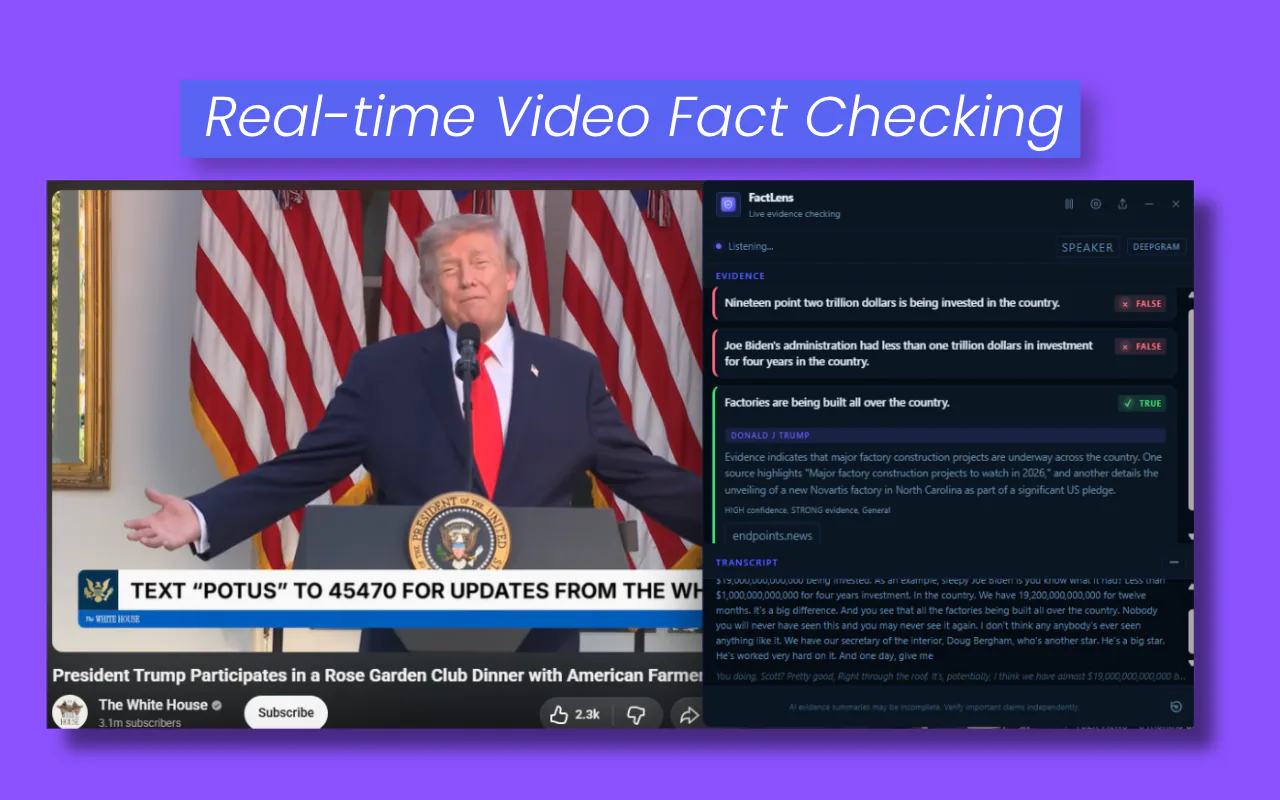
Real-time AI fact checker for audio, video, images, and text. Verify claims instantly without leaving your active browser tab.
Vibe coding tools like Bolt and Lovable promise effortless software creation, but the rise of AI-generated fake websites, fake books, and hallucinated code libraries demands a transition from blind trust to active verification.
Audiences are increasingly dismissing whether an image or video is AI-generated as long as it fits "the vibe." Discover the psychology behind aesthetic fakes and how FactLens intercepts viral manipulation in real time.
Algorithmic feeds are flooded with automated, low-effort video loops. Learn how these systems operate and how to use live verification tools to audit what is real.
AI tools can turn long podcast episodes into viral shorts in seconds. But when algorithms prioritize engagement over accuracy, critical context gets left on the cutting room floor. Here is how to spot context stripping and verify claims on the fly.
As open-source personal AI agents like OpenClaw go viral alongside absurd spin-offs like Moltbook, separating true utility from social media hype is harder than ever. Discover how to evaluate these agentic breakthroughs safely using FactLens.
As Google rolls out its Universal Cart and Gemini Spark assistant, automated AI agents are taking over our purchasing decisions. Discover how these systems are manipulated by hidden web exploits and how to build a robust verification workflow.
Viral screenshots of AI chatbots making bizarre or dangerous claims frequently flood social media. Discover how easily these systems are manipulated via web-source poisoning and how to use live verifiers to protect yourself.
Equip young digital investigators with a modern, media literacy workflow that integrates FactLens to audit visual claims, trace media provenance, and stop the spread of misinformation in real time.
Even professional fact-checkers overlook evidence and apply inconsistent standards. Discover how to use FactLens as a transparent peer-review engine to audit the verifiers and build an accountable chain of custody.
When synthetic media can fabricate corporate crises in seconds, traditional breach response is no longer enough. Discover how to merge FTC protocols with real-time verification to protect your communication perimeter.
When coordinated bot networks target your brand, manual monitoring fails. Discover an evidence-based framework for brand disinformation defense, combining tactical response matrices with real-time verification tools.
When evaluating mergers, acquisitions, or market entries, leaders are highly susceptible to taking falsified target metrics at face value. Integrating FactLens directly into corporate intelligence pipelines provides a structured check against corrupted business data.
While generative AI deepfakes dominate headlines, crude 'cheapfakes' represent an immediate threat to your brand's visual identity. Learn how to spot misleading charts, read data accurately, and protect your marketing collateral.
Visual misinformation is shifting from high-tech deepfakes to low-cost 'cheapfakes' and manipulated charts. Learn how to audit misleading graphics and protect your technical decision-making.
While high-tech generative AI dominates headlines, crude modifications of charts and videos are doing the heavy lifting of online misinformation. Learn how cheapfakes work and how to systematically verify them.
Discover how subtle data manipulation and 'cheapfake' chart adjustments damage fundraising efforts. Learn to spot misleading graphs, build trust with investors, and use FactLens to verify startup metrics in real time.
A global warning from the International Organization for Migration reveals how high-paying remote job advertisements on social media are being used by criminal networks to traffic educated professionals into forced cyber-scam operations.
Using the recently debunked campaign against Florida congressional candidate Carey Baker as a case study, we break down the anatomy of misleading television ads and provide a practical guide to verifying claims yourself.
While deepfakes dominate headlines, a simpler and more pervasive threat is mislabeled media misinformation—using real, unmodified photos and videos with false context to deceive audiences.
Synthetic political commentators are shifting the battleground of electoral manipulation. Discover how these hypocrisy-proof virtual figures operate and learn practical methods to audit automated persuasion campaigns.
In August 2026, California's state-level AI rule and the EU's Article 50 transparency mandates take effect back-to-back. Discover how these dual frameworks reshape synthetic media labeling, corporate liabilities, and compliance standards.
Artificial intelligence has enabled a new wave of highly convincing family emergency scams. Learn how scammers clone voices from short social media clips and how to protect your family.
As tech giants like Google and Meta sign the EU's new voluntary transparency codes, online platforms are preparing for a shift in how synthetic media is handled. Explore the new technical standards, labeling requirements, and privacy rules under the incoming regulations.
Google's SynthID represents an advance in invisible AI watermarking, but technical vulnerabilities, fragmented standards, and local open-source models limit its ability to combat synthetic media at scale.
FactLens reduces the friction of verifying online claims. It checks spoken, written, and visual content as you consume it, then presents clear classifications, supporting evidence, and source links without asking you to trust another black box.
A note on building a parent company for focused technology products.